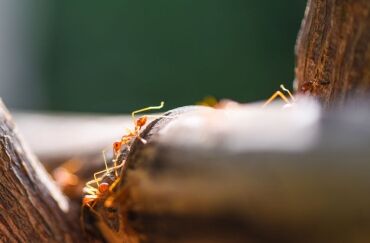
Ants are the most commonly encountered insects within homes and buildings, and a variety of ant species inhabit urban and suburban areas where they serve as pests of structures and/or cultivated landscapes. When it comes to most ant species, reproductive swarmers (alates) initiate new colonies during mating season. New colonies are typically established within moist soil, tree hollows, moist and decayed wood like stumps and fallen branches, and beneath objects like stones, wood piles, and bundles of plant-litter. Most alates within a reproductive ant swarm die before mating, and the very few females that manage to mate with a male will usually survive long enough to become the queen of a new colony. Male alates always die shortly after mating, which is why ant colonies do not include a monogamous king and queen as termite colonies do. Some ant pests do not establish new nests by swarming, and this is especially the case when it comes to many invasive ant pest species.
A few non-swarming ant species are common pests in Massachusetts including Pharaoh ants (Monomorium pharaonis), longhorn crazy ants, (Paratrechina longicornis), and European fire ants (Myrica rubra). Interestingly, European fire ants swarm regularly in their native range, but they have never been observed swarming in their invasive northeastern US habitat. Also, while non-swarming ant species are almost exclusively invasive pests, the native odorous house ant (Tapinoma sessile) demonstrates pest behaviors that are characteristic of invasive species, such as forming large colonies that contain numerous queens that disperse without swarming. These ant pest species live in colonies that grow to contain a very high number of individuals that inhabit a network of interconnected sub-nests around the original parent nest.
While most ant species live in colonies presided over by a single queen, non-swarming ant species live in colonies inhabited by numerous queens that often leave their home nest in order to start a new nest built by a group of absconding workers. In fact, workers may leave existing nests to start new nests elsewhere with or without a queen or secondary reproductive specimens. This occurs when workers kidnap a few offspring (eggs, pupae, and larvae) in order to transport them to a new nesting site where the workers raise the offspring to become secondary reproductives. Non-swarming ant species are particularly difficult to control due to their ability to rapidly establish new indoor nesting sites, and eliminating infestations requires all nests to be located and destroyed.
Have you ever had ant pests establish multiple nests in your home?